

In sports, there are official terms that players and fans can find in official rulebooks. And then there are entire other vocabularies that are made up of slang around the world.
These terms are fluid and often hard to track from a linguistic point of view. But a lot of these terms can be explained contextually. Here, we’ll look at the term “crack” and what it means to soccer fans around the world.
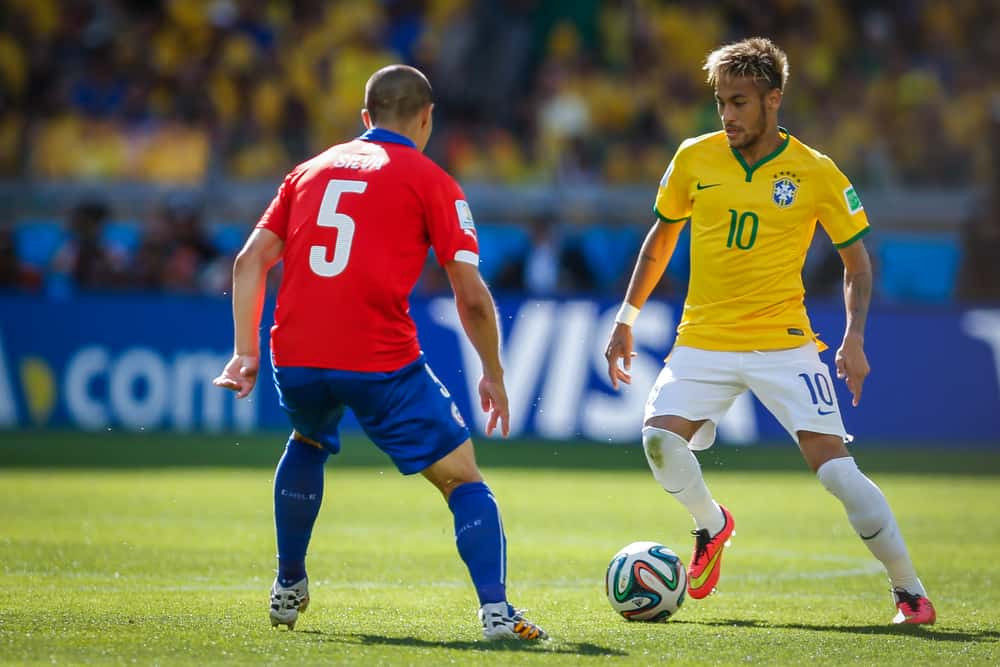
What does the term “crack” mean in soccer? A crack in soccer generally refers to a player who excels on the field and has a significant impact on the team from both a skills point of view and a leadership point of view. Examples of so-called crack players are Lionel Messi, Cristiano Ronaldo, and Neymar.
Using the Term In Spanish and Portuguese
In Spanish, the term crack is used as a noun. For example, you might say, “Joanna is a crack.” That’s understood in the context to mean that Joanna excels at her game.
It’s also used in the same way when discussing Brazilian soccer players. However, if you see the term written in Portuguese, you may see that it’s spelled craque.
Using the Term In English
If you call someone a crack and you’re speaking English, you might get some strange looks. But the term can be used as an adjective, which is a word that describes a noun. As a quick example, in the sentence, “A purple plum grows,” “purple” is an adjective describing the noun “plum.”
So in English, especially in England, someone may say, “Mo Salah is a cracking player,” or, “That was a cracking goal!” This would mean that the player or action was excellent.
Merriam Webster defines cracking as “very impressive or effective: great” and “very, extremely.” In the US, “crack” may be a shortened form of “crackerjack,” which is defined as “a person or thing of marked excellence.”
Other Contexts
There may also be some correlation between the idea of an extremely hard hit, i.e., the boxer cracked him across the cheek, or the term being a “crack shot,” which means someone who is an excellent marksman. Both of those connotations show proficiency and power so that they may have bled over into other sports.
In some other contexts, “crack” can be a verb that means to make an attempt. “Take a crack at it” means to give it a try. That’s a positive connotation and can be used as a statement of support.
In the Larger World
As with many sporting terms, “crack” has made it off of the field and into the common lexicon. L.A.-based athletic streetwear company Crack FC offers clothing inspired by the mentality of a crack player. Their gear offers such phrases as “Master Your Craft” and “Being a crack is leadership.”
They also provide their own definition of crack, which they printed on a hoodie. “A person manifesting an aura of genius. The blueprint of a crack, work on your craft. Master your craft. Be the best at whatever it is that makes you happy.”
Teams Need Cracks


No matter the exact root of this word, it’s clear that “crack” is a good thing when it comes to soccer. Managers want those types of players, and it can cost quite a bit of money in today’s game. Getting those top players is further complicated by the financial fair play regulations.
When building any elite sports team, it’s critical to have players who have the physical skills and leadership qualities that inspire their other players.
However, there can be issues with competing egos. Too many elite players can sometimes clash, so it’s up to an organization to bring the correct people together so their club can have success.
Manchester City’s Crack Problems
In 2015, Manchester City manager Manuel Pellegrini said his team needed “a crack, another special player just to give [the team] that sense that we are now at another level.” Pellegrini would agree that they had some outstanding players, explicitly calling out Sergio Aguero.
Aguero is an Argentinian player who announced his retirement in December of 2021 after 18 years of playing professionally. He made over 600 appearances in his career and scored over 320 goals in that time.
He holds many records, and at the press conference discussing his retirement, a journalist asked how he hoped fans would remember him. He answered that it would be wrong if he said he was a crack, which brought some levity to the emotional occasion.
The reporter replied that he was indeed a crack player, and Aguero reiterated that he couldn’t be the one to say that he was a crack player. Although it’s a compliment, calling oneself a crack player would seem egotistical.
And besides, Aguero played for Manchester City while Pellegrini was crying out for a crack player, so at least one person thinks Aguero wasn’t deserving of such a title.
Warring Egos
Professional athletes can sometimes have egos that get in the way of their reputations, regardless of their actual skill. Some of the best players in the world have the most oversized egos, and that’s true across any and all sports.
Having two or more egotistical players on a team can be disastrous. Kobe Bryant and Shaquille O’Neal’s feud is one of the most famous examples of egos causing issues on the Los Angeles Lakers.
So a crack player mustn’t cause tension on a team. Diego Maradona is one example of a player who had famed leadership skills coupled with immense talent on the pitch.
Despite the uniqueness of Maradona’s talent, his teammates and competitors frequently commented on his connection with his teammates. A crack player will trust and be trusted by the other people on the pitch, and that trust will allow the entire team to flourish, not just one player.
Actual crack players believe in themselves and their team, and they can use their physicality and personality to elevate their club to the next level. It’s no wonder that a crack player is elusive.
Managers and players need them, but finding that player who can make the difference and being able to afford that player…well, it’s no easy feat.
