

The GK has pulled off a world-class save and then rolls out the ball to the RB, whose excellent crossfield pass to the False 9, a player with the talent to thread a ball through the eye of a needle. The through ball to the CF is perfect, and the net bulges; the crowd goes wild!
Okay, so you won’t see it phrased quite like that most of the time, but with so many acronyms in soccer, it’s easy to forget just what each means.
Today we’re going to break down just one, the CF position; what is a CF? What do they do? Why?
CF=Center Forward


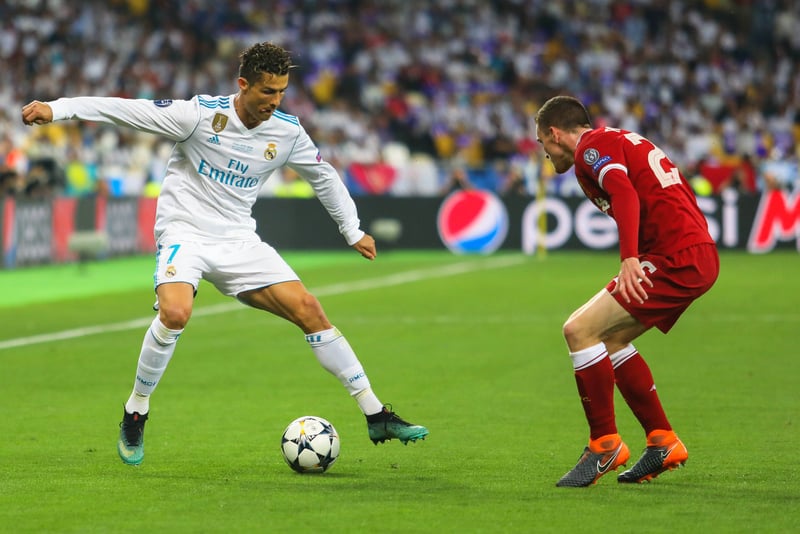
CF stands for center forward. In their truest form, center forwards are the players furthest up the pitch, and their primary responsibility is to score goals for their team. Typically, a center forward wears the number 9 soccer jersey, and this indicates that they are the main goalscorer for their club.
A center forwards needs several skills to be able to be effective in the role; the ability to hit the target, good positional sense, and the strength to hold off defenders all make for a good center forward. Many clubs use a lone center forward, so patience is a crucial attribute too.
Being able to shoot with both feet is a huge plus, as is being good in the air; a center forward may not get many chances in a game, so the ability to get a shot off in any situation increases their chances of success.
How Important Is A Center Forward?


The center forward (or striker) is one of the most important positions in soccer. Very few teams play without a player up front; Manchester City has had success without a center forward, rotating their players so that anyone could be the player whose final touch could lead to a goal. This is a rarity, though, as the discipline needed is incredible, as is the skill level required of every player.
A good center forward is invaluable to their team; chances are rare, especially at the very elite level of soccer, so each opportunity has to be taken.
Unsurprisingly, some of the most expensive players in history have been center forwards; goals win games, and the more trouble a center forward causes, the further an opponent has to play in their own half.
Tactics Matter
A common tactic in the modern game is the 4-2-3-1 formation, which has a lone center forward in front of a three-person attacking midfield. While this tactic is proving to be very effective, it does rely on the center forward being either a complete predator or having the ability to hold up the ball to allow the other attacking players a chance on goal.
A tactic that employs two players up front can often make life easier for the center forward, as they have either another CF leading the line with them or another variation on the forward role, such as a false nine or number 10.
The benefit of having a combination of roles up front means that one player often drops deeper for the ball, while the CF can be ready to finish an attacking move off. A target forward can be employed with a CF, with the creative players in the team using the target forward to aim for; the target forward can then distribute to the CF for a shot on goal.
The 4-4-2 tactic is an old favorite of the English divisions, with a four-person midfield utilizing the wings to get crosses in for the forwards. A CF is usually combined with another player to form a partnership up front that, when used properly, can be devastatingly effective.
Creating Partnerships
Having two players up front, a CF and either a target forward or a false 9, allows the team multiple outlets for scoring goals. A good partnership can reap serious rewards, especially if the two forwards get enough game time to become a more cohesive unit.
Some of the best center forwards in soccer have played as part of a two-person strikeforce; Sutton and Shearer, Cole and Yorke, Henry and Bergkamp all had incredible partnerships for their clubs. It’s noticeable that each player had very different characteristics, which allowed both players to thrive and score many goals without getting in each other’s way.
Having two CFs in the same lineup means there’s a chance that both would find themselves in the same positions, trying to get to the same through-balls, which would cause serious problems. The CF needs space to operate and uses the false 9 to drop back and create chances, or the target forward to bring the ball down, hold it up, and then feed the CF for a shot.
Confidence and Selfishness
A center forward needs absolute faith in their ability to score goals, as there will be long periods of time where the ball just isn’t going their way. Getting into the right position time after time, a CF might never receive the ball but has to keep assuming they will eventually have a chance.
The arrogance and self-belief to keep going and the selfishness to ignore a better-placed teammate make the CF position lonely. If the CF scores, they’re the hero, especially if they’re seen to be working their socks off to get into the right areas of the pitch. That one chance of a shot might be all the CF receives, so they have to take it.
Center forwards often have barren spells where nothing seems to go their way, the ball never arrives, or the defense is on top form; perhaps the keeper is having one of those games where nothing gets past them. It’s a center forward’s job to not get discouraged, even after a ten-game barren spell; eventually, a goal will be scored, and often that opens the floodgates.
The Lone Center Forward
A lone center forward has one of the most challenging jobs in soccer; they’re expected to lead the line, provide the goals, and invariably have to do so with up to four defenders keeping a close eye on them. The 4-2-3-1 formation we discussed earlier is a great one for keeping it tight at the back while being able to counter-attack quickly, but it can leave the CF isolated.
Without possession, the formation becomes more compact as the wingers drop deeper to recover the ball. The CF stays up front alone, waiting for the ball to be recovered and the team to begin attacking. The CF needs mobility, their movement off the ball is key to getting into position, and they also need the strength to hold off defenders.
Once the ball is in transition, the CF has to be ready for a cross or through-ball. There’s one problem; the defenders know precisely who the target is and outnumber the CF by up to four players. The CF is judged on their goals, so they must find a way to evade or outwit their markers and hope their teammates can deliver the ball exactly where they need it.
Glory Hunters
It takes a special kind of mentality to be a center forward; it’s a hard job with immense pressure attached. It’s also one of the team’s most important and exciting roles, so it often attracts players with incredible self-belief.
A CF low on confidence won’t score, but once the goals start flowing, they’re the club’s heroes, loved by fans and adored by the media. It’s for these times that a player becomes a center forward when everything is going well, and they can bask in the glory of being an elite center forward.
