
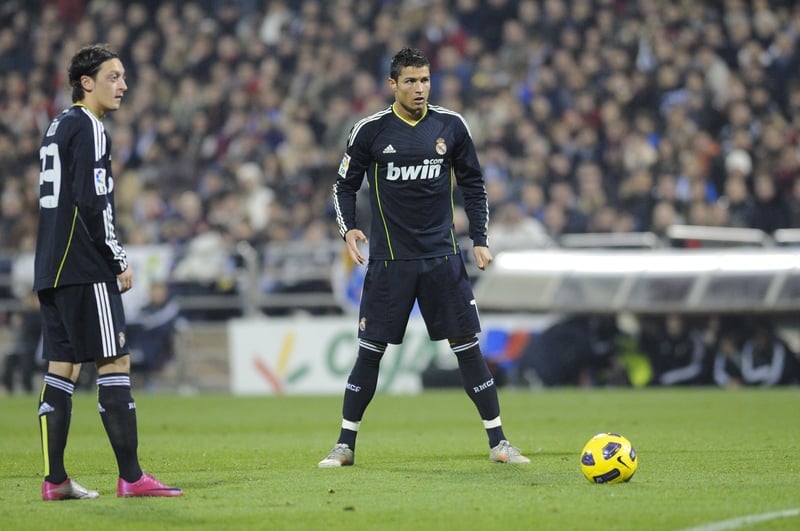

Few things in soccer can lift a crowd more than the anticipation of a free kick; a foul has already been committed, tempers are fraying, and now your team has a chance to put the ball into the opponent’s penalty area, maybe even the back of the net. It’s a tactic that’s practiced often at the training ground; the chance of glory for your freekick specialist.
But there’s a fair bit of difference between a direct free kick and an indirect one, and each has its own advantages and disadvantages.
A team that comes prepared can often win against the odds. Having a training routine set up to take advantage of getting a free kick can be vital, especially against superior opposition.
We’re going to take a deeper look into the two types of free kicks and see if one has a distinct advantage over the other. What are the rules for direct and indirect kicks? Who decides who takes the kick?
The difference between a direct and an indirect free kick is that a player can score from a direct free-kick, but not from an indirect free kick. Direct free kicks are the most common type of free kick and are awarded when a foul is made, while indirect free kicks are awarded when a foul is made without any contact involved.
Direct Free Kick


Players that can frequently score from a direct free kick are one of the most valuable assets in soccer; the ability to tune out the crowd, ignore the pressure, and find the top corner of the net from 30 yards away, is invaluable to a team.
Some players love the attention; some simply stroll up, score a world-class goal, and then amble back to their position.
The fans love a direct free kick; the game stops for a foul, and the anticipation levels rise; this could be the chance for that all-important goal. Referees use hand signals to determine what type of free kick is to be taken; a raised arm means an indirect kick, and a horizontal arm indicates a direct kick.
A direct kick is an opportunity for a player to have a shot on goal without the opposition interfering; a skillful player can be hugely influential, and the skill to consistently hit the target from a free kick can be priceless.
The opposing players can create a wall to try and impede the free kick taker but must be a minimum of 10 yards away from the ball.
A player with the ability to hit a direct free kick over or around the wall of opposing players at pace, and beat the goalkeeper, can turn draws into victories.
Several of the best players in world soccer are also excellent free-kick takers; Andrea Pirlo, Cristiano Ronaldo, Lionel Messi, and many more have turned taking a free kick into an art form.
If the taker of the direct free kick suddenly takes the ball and moves away with it in an attempt to dribble the ball upfield, the opposing team is awarded an indirect free kick; a direct free kick must result in a single strike of the ball at goal.
The following is a list of reasons a referee may award a direct free kick;
- Pushing or striking an opponent.
- Headbutting (also risks a straight red card).
- Holding, biting, or spitting.
- High feet – if a foot is deemed high enough to injure a player.
- Tackling an opponent without making any contact with the ball.
- Handball – except in the penalty area, which results in a penalty kick.
- Tripping an opponent.
- Charging a set piece such as a free kick.
- Most direct physical contact that is deemed dangerous or illegal results in a direct kick.
Is a Penalty Classed As a Direct Free Kick?
A penalty kick is awarded if a player is fouled inside the opposing team’s penalty area or an opponent handles the ball inside their own area.
Unlike other free kicks, a wall is not formed for a penalty kick; the only players involved are the goalkeeper and the kick taker. This direct free kick is the most dangerous in the sport and often favors the player with the calmest nerves.
Indirect Free Kick


An indirect kick differs from a direct one as the ball must be touched by at least two players before a goal can be scored.
Upon receiving an indirect free kick, the ball is placed at the spot the foul was committed, and the player steps up to take the free kick. At this point, the referee’s arm is raised vertically to identify the type of kick that has been awarded.
If you remember, an indirect kick is indicated by a referee raising their arm vertically (a good way to remember is to imagine the raised arm as an I, for Indirect). The player taking the free kick isn’t allowed to simply take a shot on goal; they must either pass or cross the ball to a teammate who can then either shoot, pass or run with the ball.
Once the ball leaves the foot of the free kick taker, the opposing team’s players can immediately try to win back possession of the ball.
Depending on where on the pitch a free kick is awarded, an indirect free kick is an opportunity to cross the ball into the opponent’s penalty area. A well-rehearsed indirect free kick can cause mayhem if appropriately executed.
Training sessions are often created to make the most of indirect free kicks, especially in the opponent’s half of the pitch. The opposing team has to try to anticipate where the free kick taker is going to aim, and at times a routine can be quite elaborate as teams look to take any advantage they can.
The reasons a referee will stop play and award an indirect free kick are:
- A player plays in a dangerous manner but hasn’t made contact with an opponent.
- The goalkeeper releases the ball and then picks it back up.
- A player takes the ball from the goalkeeper when the goalkeeper has the ball in hand.
- A player impedes another player, deliberately blocking them off from the ball.
- If a player flicks the ball into the air to head it to their goalkeeper to catch it.
- Dissent – if a player uses foul language or argues with the referee.
- The goalkeeper retains possession of the ball for more than 6 seconds.
Conclusion
Both indirect and direct free kicks have their particular advantages; a team with a talented dead-ball specialist can make the most of direct free kicks; an example is the Southampton team, a mid-table team in the Premier league.
Southampton midfielder James Ward-Prowse is a superb free kick taker, with an extremely high success rate from direct free kicks, and the team takes full advantage of this talent to often win points that would otherwise be out of reach. It’s no understatement to say that Southampton FC could have been relegated without Ward-Prowse’s abilities.
Indirect free kicks are also hugely important, provided a team can make the most out of attacking free kicks and know how to defend against them.
Many teams seem to panic in the face of a cross, especially one that’s allowed them time to think; they know what’s coming but at times struggle to handle the pressure of defending an inswinging cross.
