
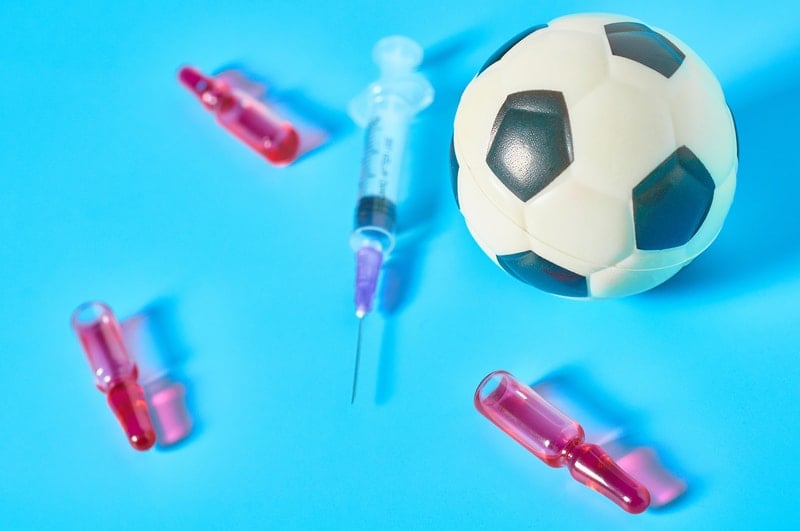

To keep a level playing field, drug testing is becoming more and more prevalent in sports. Many leagues are trying to do what they can to create a competitive balance, and even though it is tricky, it makes a lot of sense.
Are soccer players drug tested? Professional soccer players are drug tested several times throughout the year. Most drug tests are random, so a player never knows when a test happens, or how often. Most expect to have at least a few tests each season, either from the club league they play in, or international governing bodies.
Club Level Drug Testing
There is no universal testing system for soccer players all around the world. Most of it comes down to the club league and how they want to handle things. For example, the Premier League in the United Kingdom is considered the most lenient as far as infrequent testing is concerned.
Out of all the major leagues around the world, they have very few tests to use on everyone. Players are tested roughly 2 to 3 times per year on average, but there is random testing done at all times. The goal is to keep things as safe as possible, but many believe that they should be tested more often to cut down on potential drug use at such a high level.
In Italy, Spain, France, and other major leagues, testing is a little more frequent. Samples are taken throughout the year, and players can face some pretty tough drug testing. Italy seems to take testing the most serious, as players receive tests more than twice as often as players in the Premier League.
Drug Tests Are Rare In The Lower Leagues
The top leagues might all have their drug testing squared away, but lower-level professional leagues might not be so lucky. It is a fairly constant thing to do to have drug testing across-the-board, and some leagues will have to skip it entirely.
This means it is a bit of the wild west as far as potential drug use is concerned. Of course, the reason why people will use drugs is to move up into higher leagues, which will then have better drug testing that could potentially out a player.
Players are well aware of what type of drug testing goes on before signing up with a new club in a league. Some will specifically pick leagues that are a little less strict on drug testing, and it can keep them hidden for a while. Eventually, the leagues at a certain level all have strict enough testing that it is hard to fly under the radar.
International & Olympic Testing


There is perhaps no tougher and more strict testing done in soccer than the Olympics. That does not only go for soccer, but most sports. With so much history and tradition involved at the Olympics, the goal is to hold up the sport’s integrity and everything that the Olympics stand for.
The difference here is that in the Olympics, soccer is not as big as other sports. While every country wants to win in the Olympics, they send younger players and focus more on the World Cup. It is important to do drug testing in the Olympics, but the top players in the world are usually not participating.
Soccer Players Doesn’t Use Steroids
When people think of drug testing in sports, the first thought for many includes steroids. The use of steroids is to help with overall strength, but in a sport like soccer, that is not really necessary. While it does help to have some strength, players are not trying to build up their muscle to play a physical sale of soccer.
The more common type of drug use has to do with stamina. Using an EPO to increase stamina is something that makes sense for players looking to gain an edge. The game is faster and more physical than ever, which means that players can be really struggling by the end of the match. Having an edge of some sort to get through those tough times is crucial.
Players are already doing as much as possible to gain an edge in the competitive world of soccer the legal way. Diet and training is more of a science and ever before. Teams will have staff dedicated to making sure that players are doing everything legally to be in the best physical shape possible.
Drug Testing For Recreational Drug Use
Like many other sports, soccer will also test for recreational drug use. While it might not make as much of a big deal as it did in the past, teams want to know if players are developing a habit with drugs that could severely hamper performance. Maybe it is not giving them advantage, but it could be playing with their overall ability.
Plenty of high-level players have faced sanctions for recreational drug use. Maybe the biggest example happened in 1991, when Diego Maradona failed hey drug test based on cocaine use while playing for Napoli. This was a shock to some, even with speculation that he was constantly using recreational drugs.
A bigger hit to his legacy came in 1994, as Maradona is also the biggest name to fail a performance-enhancing drug test. He received sanctions for 18 months for taking ephedrine. This basically ruined the opportunity for Argentina to make a push in the 1994 World Cup. He played in the first two matches, even scoring one goal against Greece, before being sent home for the failed drug test.
How Effective Is Drug Testing In Soccer?
The numbers would show that soccer does not have much of a problem as far as performance-enhancing drugs are concerned. There are a few busts here and there, but there have not been any major scandals like in some other sports.
However, there are always going to be those people who believe that the drugs used by top players are a step ahead of the testing. There might be some truth to that, but it is hard to nail down exactly what is going on if players continually pass the drug test they are given.
In a sport so reliant on physical fitness, there are certainly players trying to push the limits as much as possible. Even getting a slight edge from a physical standpoint can be a difference-maker. It is a dangerous game playing with drugs, but also an avenue to a greater career if a soccer player can get away with it.
